Sleep tracking on modern wearables looks impressively precise.
A watch can tell you that you slept for 6 hours and 41 minutes, including 1 hour and 28 minutes of Deep sleep, 1 hour and 29 minutes of REM, plus a few minutes awake. Once you have enough numbers displayed down to the exact minute, it becomes very easy to treat them as exact measurements.
But what happens if you wear four modern sleep trackers at the same time?
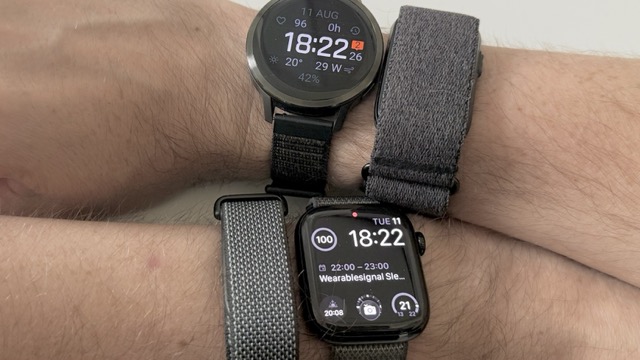
For seven nights, I slept with an Apple Watch and Fitbit Air on my left wrist, plus a Garmin Venu 4 and Garmin CIRQA on my right.
The goal wasn’t to determine which device measures sleep “correctly.” Without polysomnography, or at least EEG, I don’t have ground-truth data against which I can validate sleep stages.
Instead, I was interested in a simpler and more practical question:
If four modern wearables observe exactly the same nights, how similar will their results actually be?
The answer depends heavily on the metric.
All four devices reported almost identical overnight heart rates. The two Garmin devices produced nearly identical HRV values. Total sleep duration was generally in the same ballpark as well.
But once we get to Deep and REM sleep, the four devices start telling noticeably different stories.
How I Tested Them
I wore all four devices simultaneously.
On my left wrist:
- Apple Watch, closer to the hand
- Fitbit Air, positioned above it
On my right wrist:
- Garmin Venu 4, closer to the hand
- Garmin CIRQA, positioned above it
Obviously, this isn’t a laboratory setup. If you wear four devices at once, two of them inevitably have to sit slightly higher on the arm. But their positions remained consistent from night to night, and all four were observing the same sleep.
I also made sure the two Garmin devices couldn’t mix data through the same ecosystem.
CIRQA and Venu 4 were connected to separate Garmin Connect accounts running on two physically separate phones. Each device recorded and processed its nights independently.
Apple Watch sleep data and overnight HRV came through Wellhero.
There is one limitation with Fitbit Air. Google Health doesn’t expose HRV specifically for the sleep period, so the Fitbit HRV value available to me covers the entire day. For that reason, Fitbit Air isn’t included in the direct HRV comparison with Apple Watch and Garmin.
The experiment actually ran for more than seven nights, but I excluded two of them.
On one night, I simply forgot to wear the Venu 4. On another, CIRQA lost the entire night’s data after charging, which I’ll get back to later.
That left seven nights with a complete dataset from all four devices.
Sleep Duration: Surprisingly Close, But Not Always
Average sleep duration across the seven nights was:
| Device | Average Sleep Duration |
|---|---|
| Garmin Venu 4 | 5h 54m |
| Garmin CIRQA | 5h 56m |
| Apple Watch | 6h 11m |
| Fitbit Air | 6h 20m |
At the weekly-average level, the two Garmin devices were almost identical.
Apple Watch recorded slightly more sleep, with Fitbit recording a bit more again.
But those averages hide an important detail.
The closest pair on individual nights was actually Apple Watch and Fitbit Air. Their mean absolute difference was only about 9 minutes per night, with a median difference of around 8 minutes. The largest difference across the seven nights was 30 minutes.
The two Garmin devices ended the week with almost identical averages, but individual nights matched less closely.
The mean absolute difference between CIRQA and Venu 4 was roughly 25 minutes, with a maximum difference of 83 minutes.
So two devices can finish a week with nearly identical average sleep duration while disagreeing by more than an hour on a particular night.
It’s a good example of why a weekly average can make agreement look better than the underlying nightly data really is.
Sleep Stages: This Is Where Things Get Messy
Average nightly sleep stages looked like this:
| Device | Deep | REM | Light/Core |
| Garmin CIRQA | 1h 30m | 41m | 3h 45m |
| Garmin Venu 4 | 1h 36m | 38m | 3h 40m |
| Apple Watch | 51m | 1h 28m | 3h 51m |
| Fitbit Air | 1h 02m | 1h 10m | 4h 07m |
And now we’re dealing with differences on a completely different scale.
Both Garmin devices consistently classified much more of my sleep as Deep and considerably less as REM.
Apple Watch sat almost at the opposite end of the range.
Venu 4 reported roughly 45 minutes more Deep sleep per night than Apple Watch, while reporting around 50 minutes less REM.
CIRQA showed a very similar pattern.
Fitbit Air usually landed somewhere between Garmin and Apple.
Can I look at this table and say Apple is right and Garmin is wrong? No.
Can I say the opposite? Also no.
None of these four devices is a ground-truth reference.
But the disagreement itself is already useful:
The devices can agree reasonably well on how long you slept while completely disagreeing on what that sleep consisted of.
CIRQA and Venu 4 Are Surprisingly Similar
The comparison between the two Garmin devices is particularly interesting.
Remember that they were operating independently, on separate Garmin Connect accounts and separate phones.
Their mean absolute difference was:
- 12 minutes for Deep sleep
- 11 minutes for REM
That’s considerably smaller than the difference between either Garmin and Apple Watch.
CIRQA and Apple Watch differed by an average of roughly:
- 39 minutes for Deep
- 47 minutes for REM
Venu 4 and Apple Watch differed by:
- 45 minutes for Deep
- 50 minutes for REM
Yet the two Garmin devices weren’t nearly as close when estimating total sleep duration.
So there is an interesting pattern here: they don’t always agree on exactly where sleep starts and ends, but once they have identified sleep, they classify it into stages in remarkably similar ways.
To me, that looks much more like a Garmin-specific sleep-staging pattern than random error from one optical sensor.
So What Did Researchers Find in the Lab?
My test doesn’t include EEG, but there are studies where consumer wearables have been compared directly against PSG.
One such study tested Apple Watch Series 8, Fitbit Sense, Fitbit Charge 5 and Garmin Vivosmart 4.
Agreement with PSG for four-stage sleep classification differed considerably between platforms. Apple Watch produced the strongest agreement within this group, Fitbit was lower, and Garmin Vivosmart 4 was notably lower than both.
More interestingly for this particular experiment, Garmin Vivosmart 4 substantially overestimated Deep sleep on average compared with PSG, while Apple Watch underestimated it.
That sounds rather familiar.
In my data, both modern Garmin devices also report considerably more Deep sleep and less REM than Apple Watch.
Of course, Vivosmart 4 isn’t CIRQA or Venu 4. It’s a different generation of hardware and potentially a different algorithm.
So that study doesn’t prove that my Garmin devices are wrong by any specific number of minutes.
But it does reinforce the broader point: sleep staging on consumer wearables depends heavily on the algorithm and can differ substantially between ecosystems.
In this case, my small seven-night experiment and controlled laboratory research point in a fairly similar direction.
Overnight Heart Rate Is Much More Boring
And that’s a good thing.
Average overnight heart rate was:
| Device | Average HR |
| Apple Watch | 51.7 bpm |
| Garmin Venu 4 | 52.1 bpm |
| Garmin CIRQA | 52.3 bpm |
| Fitbit Air | 52.9 bpm |
The differences on the same nights are even more interesting.
Mean absolute difference:
- CIRQA vs Venu 4: 0.1 bpm
- CIRQA vs Apple Watch: 0.7 bpm
- CIRQA vs Fitbit Air: 0.6 bpm
- Apple Watch vs Fitbit Air: 1.2 bpm
Essentially, all four devices are seeing the same overnight heart rate.
| Date | CIRQA | Venu | Apple Watch | Air |
| 2026-08-03 | 49 | 49 | 48.4 | 49 |
| 2026-08-04 | 49 | 49 | 48.4 | 49 |
| 2026-08-05 | 50 | 50 | 50.2 | 51 |
| 2026-08-06 | 51 | 51 | 50.8 | 52 |
| 2026-08-08 | 56 | 56 | 55.9 | 57 |
| 2026-08-10 | 58 | 57 | 55.9 | 58 |
| 2026-08-11 | 53 | 53 | 52 | 54 |
Against the sleep-stage results, this is probably one of the clearest findings of the entire test.
When we’re dealing with a relatively direct physiological measurement, the devices are extremely close.
Once a classification algorithm is layered on top and has to decide whether you’re asleep and which stage you’re in, the results diverge much more dramatically.
HRV: The Two Garmins Are Nearly Identical
For HRV, I can directly compare CIRQA, Venu 4 and Apple Watch / Wellhero.
Average values were:
| Device | HRV |
| Garmin CIRQA | 42.9 ms |
| Garmin Venu 4 | 43.4 ms |
| Apple Watch / Wellhero | 47.4 ms |
CIRQA and Venu 4 differed by only about 1.1 ms on average.
That’s remarkably close.
Apple Watch / Wellhero produced somewhat different absolute values, with a mean absolute difference of roughly 10 ms compared with Garmin.
But I wouldn’t try to turn this into another contest over which platform measures HRV “correctly.”
HRV depends on the measurement window, artifact filtering, aggregation method and other implementation details.
So the useful conclusion is narrower:
Two independently operating Garmin devices produced nearly identical overnight HRV when worn at the same time.
Fitbit Air isn’t part of this comparison because Google Health provides me with HRV over a different time window.
Wake-Ups Aren’t Really Comparable
I initially collected wake-up data as well.
Then it became obvious that a meaningful comparison wasn’t really possible.
Garmin reports Restless Moments. Apple and Fitbit use different definitions for Awake periods and wake-ups.
As a result, Garmin might report 20, 30 or more than 40 restless moments during a night, while Apple reports a handful of awake periods and Fitbit sometimes reports none at all.
That doesn’t mean Garmin thinks I woke up forty times.
They’re simply different metrics.
So I didn’t use wake-up counts either to compare the devices or to decide which one was more accurate.
It’s also a useful reminder of a broader problem with cross-platform wearable comparisons: metrics with similar-looking names don’t necessarily measure the same thing.
What Happens in the Morning: Four Devices, Different Approaches
There is another part of sleep tracking that is easy to lose when comparing sensors.
In the morning, the user doesn’t open a CSV with four columns. They open an app.
And the platforms approach this quite differently.
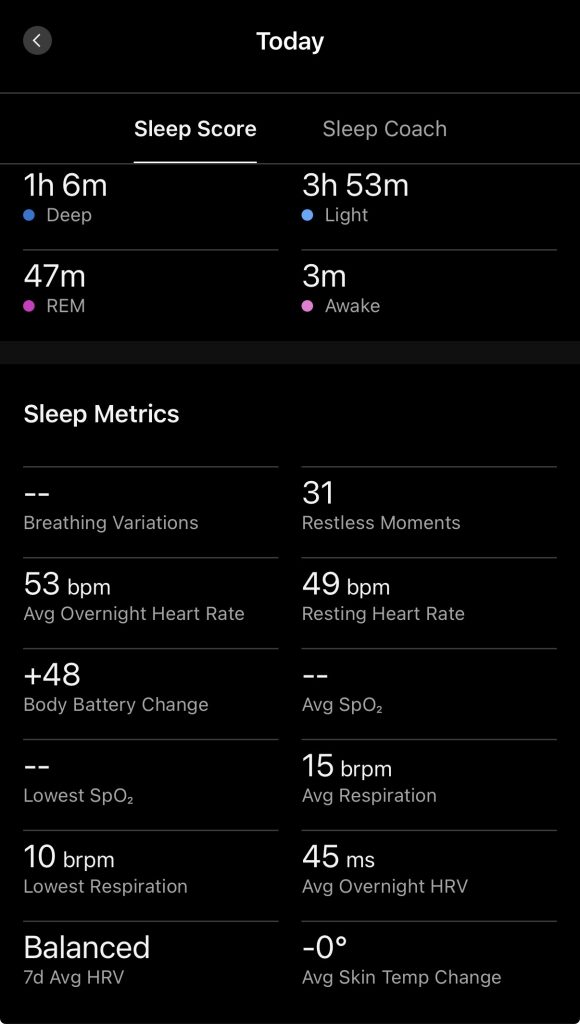
Garmin provides a lot of individual numbers. You can inspect overnight HRV, overnight heart rate, sleep duration, sleep stages and other metrics.
Garmin also has HRV Status, but that is built around a 7-day average HRV compared with your personal baseline.
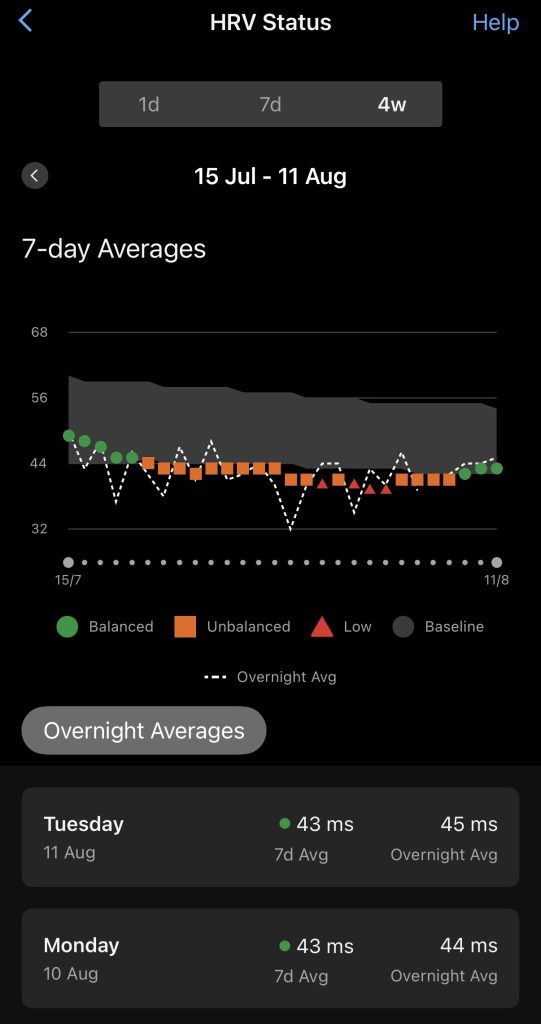
That makes sense for tracking longer-term status. But if HRV changes sharply on one particular night, that change is partly diluted by the previous six nights, so the status itself can react more slowly.
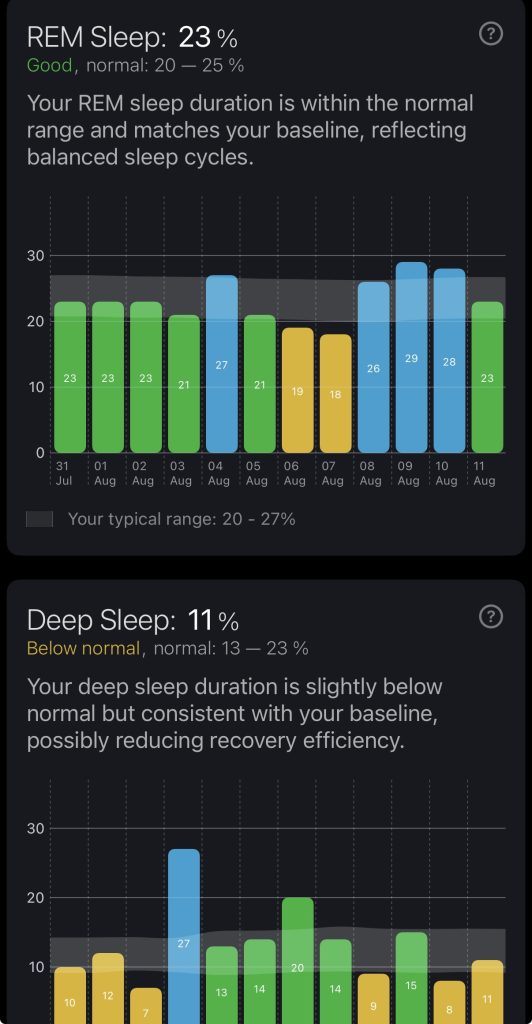
Fitbit and Wellhero put more emphasis on showing an individual night’s values relative to your own personal range. So in the morning, I don’t just see an HRV or heart-rate number. I can immediately see how far it sits from my usual values.
Wellhero also explains the sleep metrics themselves and what changes in those metrics can mean, with the basic explanations and personalized context available without a subscription.
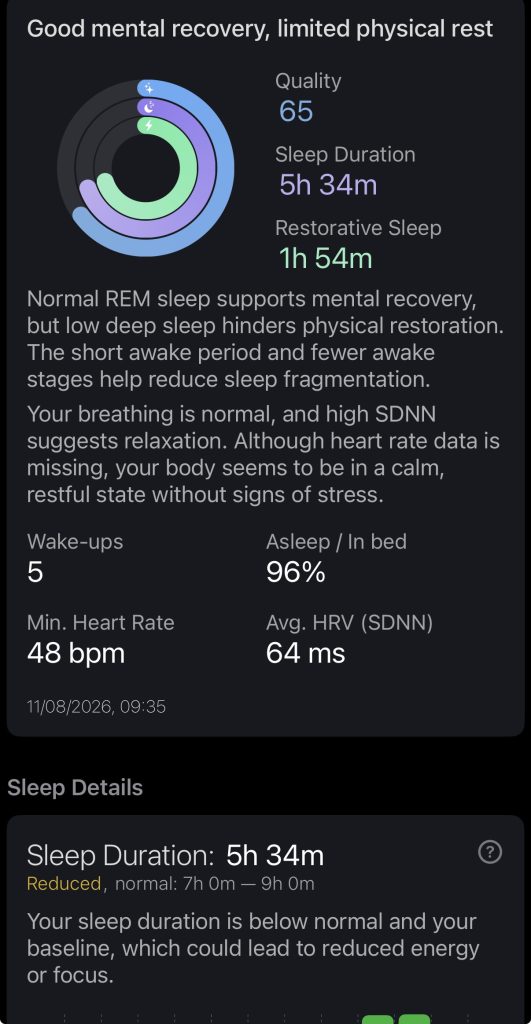
Google Health takes a similar approach to personal ranges, while the paid tier adds another layer: AI is integrated directly into the app. It can use the collected health data to describe the night’s sleep as a whole, identify changes and answer questions about the user’s own data.
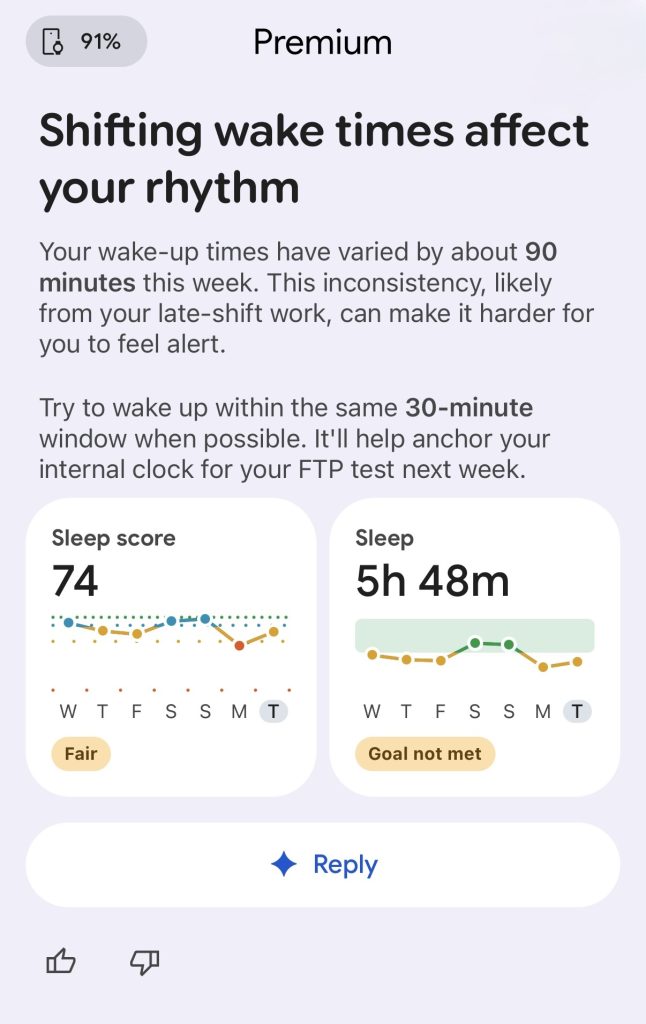
I’m not sure I need AI to tell me how I slept every morning. But from a UX perspective, it’s a much more modern approach than simply presenting another screen full of numbers.
A Week of Battery Life and a Tracker You Forget You’re Wearing
I charged Fitbit Air before starting the test, and it then lasted through all seven nights on that single charge. I didn’t do anything to extend battery life either. SpO2 remained enabled throughout.
In actual use, that mattered more than it sounds on a spec sheet. During the test, I simply stopped checking the battery.
The second observation is purely physical: Fitbit Air was the least noticeable of all four devices on my wrist.
Apple Watch and Venu 4 are full smartwatches, so comparing them with a small screenless tracker isn’t entirely fair. CIRQA is lighter than a normal watch too, but Air still disappeared on the wrist more effectively. After wearing it for a while, I would basically forget it was there.
For a sleep tracker, that’s a meaningful characteristic. If you’re supposed to wear something every night, ideally you shouldn’t have to think about it while sleeping.
CIRQA, on the Other Hand, Lost an Entire Night
During the test, CIRQA did exactly what I least want a passive sleep tracker to do.
I had it on the charger before bed. After removing it, the device still connected normally to Garmin Connect and showed around 98% battery. Everything looked fine. Except the optical sensor hadn’t switched back on. I didn’t notice and went to sleep.
The next morning, I discovered that the entire night of heart-rate and sleep data was gone. Restarting CIRQA brought the optical sensor back to life.
This is most likely a fairly ordinary early firmware bug, and I expect Garmin to fix it in an update.
But for me, the interesting part isn’t only the bug itself. It’s also Garmin’s approach to launching CIRQA.
The device was kept under near-total secrecy before release. As a result, buyers got a brand-new product before there was a meaningful body of long-term independent testing around it.
And then a production device turns up with a bug where a 24/7 tracker can silently stop performing its primary job after a completely normal charging session.
The bug will probably be fixed. But the lost night isn’t coming back. And neither can my Garmin Connect Sleep Savant badge 😅
For a device like CIRQA, this is a particularly bad class of bug. There is no screen and very little active interaction, so the user needs to be able to simply assume that the tracker is doing its job.
If I need to check before bed that the optical sensor really came back on after every charging session, the whole “wear it and forget it” concept starts to fall apart a little.
What I Actually Find Useful in Sleep Tracking
My conclusion after these seven nights is fairly simple.
I primarily pay attention to sleep duration, overnight heart rate, HRV relative to my own baseline, and temperature changes when the device supports them.
I treat Deep, REM and Light/Core more as additional context than precise measurements.
For me, the main value of sleep tracking isn’t knowing the exact number of minutes of Deep sleep. It’s having a device automatically collect a reasonably stable set of physiological data every night and making it easier to notice when something changes relative to my normal state.
