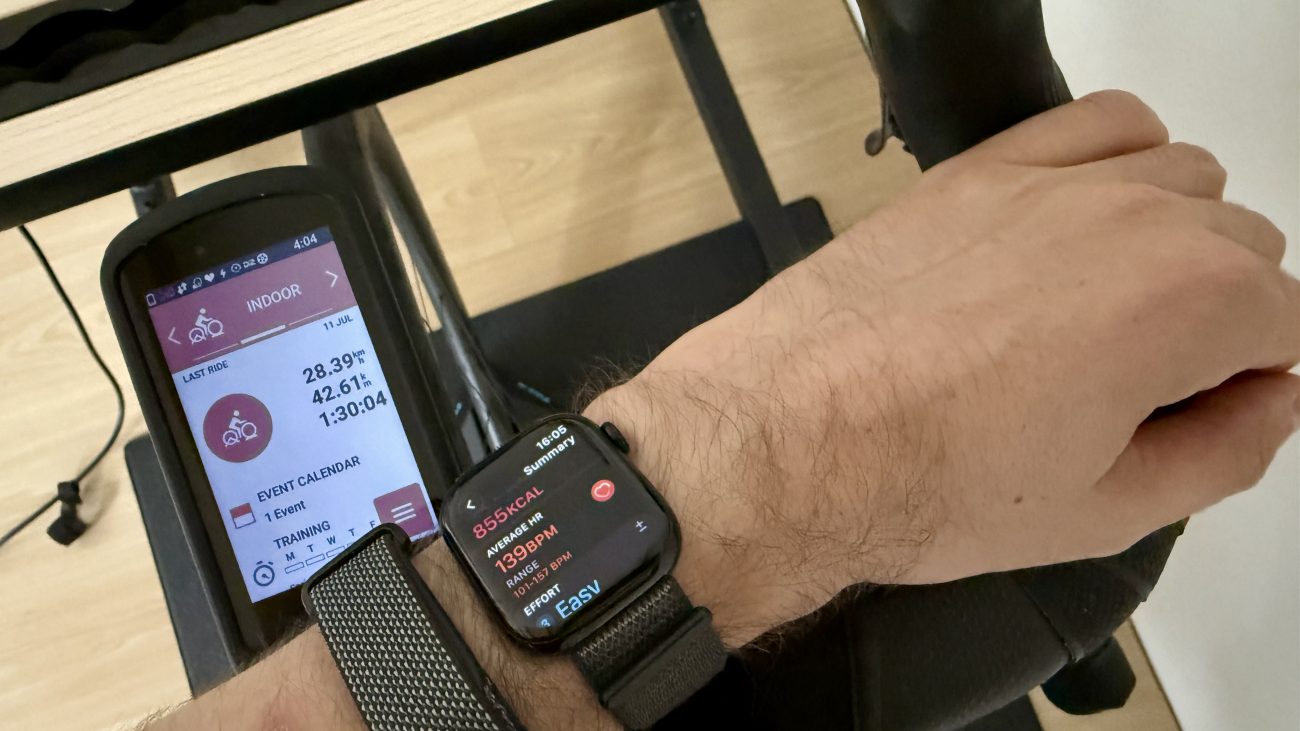
Can the Fitbit Air replace a chest strap for cycling? To find out, I compared its heart rate data with the Polar H10 during three real-world rides: a 90-minute indoor Zone 2 workout, a two-hour solo Zone 2 ride, and a dynamic three-hour group ride.
The short answer is simple: Fitbit Air is impressively accurate during steady aerobic cycling, but it is not reliable enough to serve as the only heart rate sensor during intense or highly variable rides.
How the Fitbit Air cycling test was conducted
The Polar H10 was used as the practical reference device. Unlike wrist-based optical sensors, the H10 detects the heart’s electrical activity and reacts quickly to changes in heart rate. It is not a laboratory ECG, but it is one of the best reference sensors available for real-world sports testing.
Apple Watch data was also recorded during the indoor workout and the solo outdoor ride, providing an additional point of comparison.
After each ride, the recordings were aligned by time and compared using the following metrics:
- Samples is the number of data points that matched in time between the two files.
- Window is the duration of the period being compared.
- Trimmed shows how much time was excluded when selecting the common comparison period.
- Overlap is the percentage of the time window for which both files contained data.
- Similarity is a composite score that considers graph shape, errors, systematic bias, and overlap.
- Correlation shows how closely the two graphs rise and fall together. A value near 1 indicates similar dynamics.
- MAE is the mean absolute error and represents the typical difference from the reference.
- RMSE is similar to MAE but gives more weight to occasional large errors.
- Bias measures systematic overestimation or underestimation relative to the reference.
- Max diff is the largest difference between matching data points.
Overlap depends on both missing data and recording frequency. According to the official Fitbit Air specifications, the device stores heart rate data at two-second intervals. Therefore, an overlap of about 41% does not mean Fitbit Air failed to record most of the workout. It means that approximately 41% of the time stamps could be directly matched between files.
Fitbit Air heart rate accuracy results
| Cycling workout | Samples | Window | Trimmed | Overlap | Similarity |
|---|---|---|---|---|---|
| Indoor trainer, Zone 2 | 2,203 | 1:29:50 | 0:15 | 40.9% | 87.4% |
| Solo outdoor Zone 2 ride | 3,427 | 2:17:48 | 0:33 | 41.4% | 86.9% |
| Dynamic group ride | 4,624 | 3:02:26 | 13:05 | 42.2% | 78.4% |
| Cycling workout | Correlation | MAE | RMSE | Bias | Max difference |
|---|---|---|---|---|---|
| Indoor trainer, Zone 2 | 0.981 | 1.0 bpm | 1.8 bpm | 0.0 bpm | 15 bpm |
| Solo outdoor Zone 2 ride | 0.950 | 1.3 bpm | 2.2 bpm | -0.1 bpm | 17 bpm |
| Dynamic group ride | 0.604 | 6.5 bpm | 15.0 bpm | 3.6 bpm | 90 bpm |
Polar H10 was the reference file in the first two tests. Fitbit Air showed no meaningful bias indoors and underestimated heart rate by just 0.1 bpm during the solo ride.
The comparison direction was reversed for the group ride screenshot. Fitbit Air was the reference file and Polar H10 was the compared file. The positive bias of 3.6 bpm therefore means that Polar H10 recorded an average heart rate approximately 3.6 bpm higher than Fitbit Air.
Similarity should not be interpreted as the percentage of correct measurements. It is a composite score. Better overlap can partially compensate for worse point-by-point accuracy, which becomes particularly important when comparing Fitbit Air with Apple Watch.
Test 1: 90 minutes of indoor Zone 2 cycling
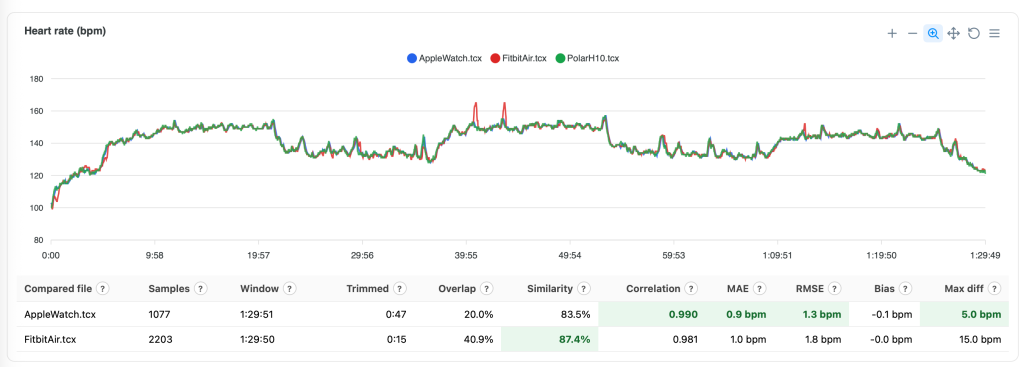
This was the strongest Fitbit Air result of the three tests.
The mean absolute error was only 1 bpm, correlation reached 0.981, and there was effectively no systematic bias. On the graph, the red Fitbit Air line is almost entirely hidden behind the green Polar H10 line.
Fitbit Air accurately followed both the steady sections at approximately 145 to 150 bpm and several transitions between easier and harder efforts. Two short Fitbit spikes at around 40 and 43 minutes increased the maximum error to 15 bpm, but they had very little effect on the overall result.
Apple Watch was slightly more accurate:
- MAE: 0.9 bpm
- RMSE: 1.3 bpm
- Correlation: 0.990
- Maximum difference: 5 bpm
However, Apple Watch received a lower Similarity score of 83.5%, compared with 87.4% for Fitbit Air.
This is explained by the difference in data density. Apple Watch produced 1,077 matching samples and 20% overlap, while Fitbit Air produced 2,203 samples and 40.9% overlap. Apple Watch was slightly more accurate at the matching points, but Fitbit Air provided a denser recording.
Indoor cycling provides favourable conditions for an optical heart rate sensor:
- The wrist is exposed to very little vibration.
- Hand position changes infrequently.
- Exercise intensity changes gradually.
- The band maintains consistent contact with the skin.
Practical conclusion: Fitbit Air is accurate enough for recording steady indoor cycling. Its data can be used to evaluate average heart rate, time in zones, and post-workout cardiovascular load.
Test 2: Two-hour solo Zone 2 ride
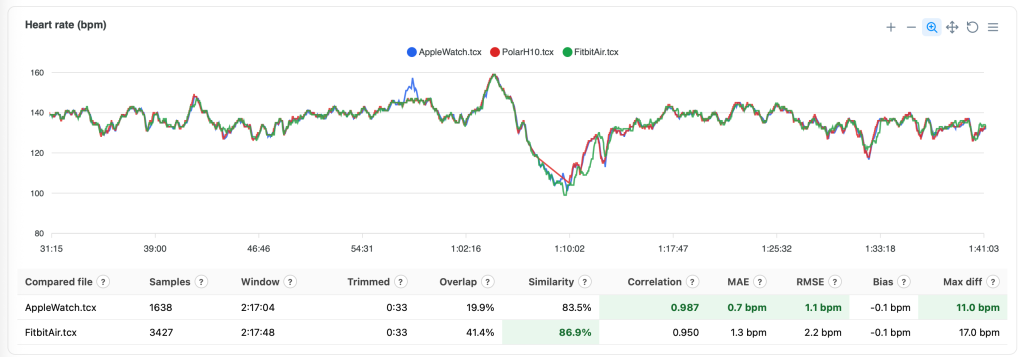
Outdoor cycling is more difficult for optical heart rate sensors. Road vibration, frequent wrist movement, changing hand positions, wind, and uneven surfaces can all interfere with the signal.
Despite these conditions, Fitbit Air again delivered a strong result.
Its MAE increased only slightly to 1.3 bpm, while RMSE reached 2.2 bpm. Correlation remained high at 0.950, and the bias was just -0.1 bpm.
In the enlarged section shown on the graph, Fitbit Air correctly follows gradual increases and decreases in heart rate, including a drop from approximately 158 to 105 bpm. During faster transitions, the Fitbit line occasionally falls slightly below the Polar H10 reading or reacts with a short delay, but these differences remain small and brief.
Apple Watch was again more accurate at the matching points:
- MAE: 0.7 bpm
- RMSE: 1.1 bpm
- Correlation: 0.987
- Maximum difference: 11 bpm
Its Similarity score was still lower at 83.5%, compared with 86.9% for Fitbit Air. Once again, this was caused by data completeness. Apple Watch achieved 19.9% overlap, while Fitbit Air achieved 41.4%.
This demonstrates why a single composite score should not replace separate analysis of accuracy and recording density.
Practical conclusion: Fitbit Air is accurate enough for analysing a steady road or gravel ride. If Zone 2 is controlled using power or perceived exertion and heart rate is mainly needed for post-ride analysis, a chest strap is not essential.
Test 3: Dynamic three-hour group ride
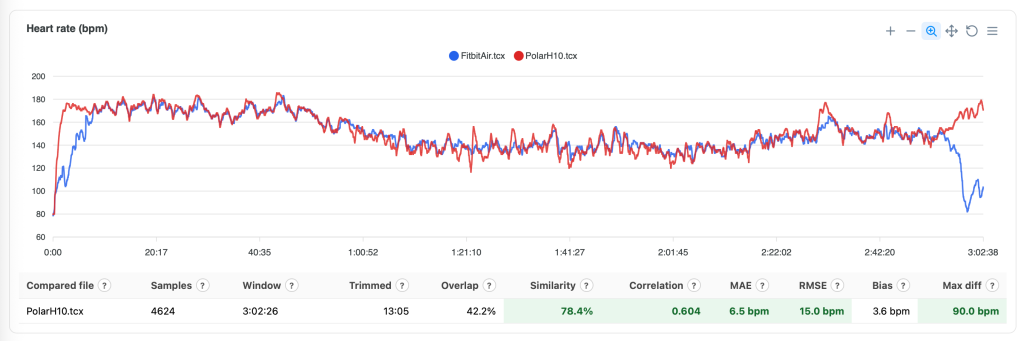
The result changes significantly during the dynamic group ride.
Correlation drops from more than 0.95 in the steady tests to only 0.604. MAE increases to 6.5 bpm, while RMSE rises sharply to 15 bpm. The maximum recorded difference reaches 90 bpm.
That maximum difference looks catastrophic, but it was not caused by Fitbit Air being consistently inaccurate throughout the ride. It resulted from two extended signal failures.
At the start of the ride, Polar H10 quickly reaches approximately 170 bpm. Fitbit Air remains between roughly 105 and 155 bpm for several minutes before eventually catching up.
The same problem returns near the end of the ride, but more severely. Polar H10 records an increase toward 170 to 180 bpm, while Fitbit Air drops to approximately 80 to 110 bpm.
Between those two failures, Fitbit Air follows the Polar H10 surprisingly well for most of the ride. It captures the general decrease in heart rate during the middle section, the subsequent increase, and many of the shorter accelerations.
The main problem is therefore not a constant 6.5 bpm error. The problem is that Fitbit Air can produce good data for a long time and then suddenly record a physiologically impossible heart rate.
This is particularly important during group cycling. During accelerations, rough roads, cornering, and changes in riding position, the hands become tense and the wrists move constantly. An optical sensor can lose contact with the skin, confuse rhythmic vibration with heart rate, or take too long to recover after losing the signal.
Google acknowledges this limitation in its heart rate tracking instructions. The company notes that cycling can interfere with wrist-based heart rate measurements because riders frequently bend their wrists. Google recommends wearing the tracker slightly higher and tighter during exercise, without restricting blood flow.
Practical conclusion: Fitbit Air cannot currently be considered a complete Polar H10 replacement for fast group rides, races, or interval workouts. The post-workout averages may look reasonable even if the tracker missed one of the hardest parts of the ride.
How heart rate errors affect cycling metrics
An error of one or two beats per minute rarely changes the interpretation of a steady endurance workout. A sustained drop from 170 to 90 bpm is very different.
Such a failure can significantly distort:
- Time spent in heart rate zones
- Active Zone Minutes
- Estimated cardiovascular load
- Calorie expenditure
- The recorded intensity of a group ride
- Recovery recommendations based on workout load
Average heart rate is particularly easy to misinterpret. Several minutes of underestimation can be hidden by otherwise accurate data and may not look suspicious in the final workout summary.
The full heart rate graph and time-in-zone distribution are therefore more useful than a single average value.
How to improve Fitbit Air cycling accuracy
Wear the tracker higher and tighter
Place Fitbit Air above the wrist bone and tighten the band before starting the ride. It should not move, rotate, or slide around the wrist, but it should not restrict circulation.
This is the most important practical step because cycling involves frequent wrist movement and constant pressure through the handlebars.
Keep Fitbit Air covered in rain and cold weather
When riding in the rain, wear Fitbit Air under the sleeve of your rain jacket. In cool weather, place it under the sleeve of a long-sleeve jersey.
This helps protect the sensor area from rain, cold wind, and rapid cooling of the skin, all of which can make optical heart rate measurements less reliable. There is no downside to covering the tracker because Fitbit Air has no screen to check while riding.
Start the cycling workout manually
Fitbit Air does not have a screen, so workouts are controlled through the Google Health app.
Starting the activity manually reduces the risk of automatic detection missing the beginning of the ride. It also makes it easier to confirm that the tracker is recording before the intensity increases.
Check the heart rate before the first hard effort
Fitbit Air can share live heart rate over Bluetooth using the Share Heart Rate function. If your indoor trainer, cycling app, or bike computer supports the connection, check that the displayed value is plausible before beginning an interval or joining a fast group.
Google provides instructions for sharing Fitbit Air heart rate with fitness equipment and apps.
Inspect the graph after an intense ride
Do not rely only on average heart rate, calories, or Active Zone Minutes.
A sudden decrease of several dozen beats per minute during an acceleration almost certainly indicates signal loss rather than rapid recovery.
Keep using a chest strap for important workouts
A chest strap is not necessary because the difference between 148 and 150 bpm matters. It is necessary because it is less likely to lose the signal during rapid intensity changes, vibration, or difficult riding conditions.
For intervals, races, fitness testing, and fast group rides, Polar H10 or another high-quality chest strap remains the safer choice.
Can Fitbit Air be the primary fitness tracker for a cyclist?
It depends on what “primary” means.
As a 24/7 health and recovery tracker, Fitbit Air is compelling. It weighs only 12 g with the band, stores heart rate at two-second intervals, tracks sleep and HRV, and offers up to seven days of battery life. Its screenless design also avoids duplicating the information already shown on a cycling computer.
The official details on sensors, weight, recording frequency, and battery life are available on the Google Fitbit Air specifications page.
As the only sports heart rate sensor for serious cycling, it is less convincing.
Accuracy was excellent during the indoor trainer workout and the steady outdoor ride. However, the dynamic group ride exposed the most dangerous type of error for an athlete: not a small and predictable offset, but a sudden and prolonged loss of the real heart rate.
The best setup for a cyclist would be:
- Fitbit Air for continuous sleep, HRV, resting heart rate, and daily activity tracking
- Fitbit Air alone for easy and steady endurance rides
- Polar H10 or another chest strap for key workouts, intervals, races, and fast group rides
Fitbit Air’s performance should not be dismissed. For a 12 g screenless tracker, its accuracy during steady indoor and outdoor cycling is impressive.
But these three tests reveal a clear boundary: Fitbit Air is excellent for continuous monitoring and steady aerobic cycling, while a chest strap is still necessary when reliable heart rate data matters most.
Limitations of this Fitbit Air cycling test
This was a real-world comparison involving one Fitbit Air unit and one rider. It was not a controlled laboratory study.
The results may be affected by:
- Band fit
- Skin characteristics
- Temperature
- Road surface
- Hand position
- Firmware version
- Synchronisation of exported workout files
Three rides are not enough to determine how frequently Fitbit Air loses heart rate during dynamic cycling.
The correct conclusion is therefore not that Fitbit Air always fails during group rides. It is that Fitbit Air can produce extremely accurate cycling data, but its reliability during dynamic riding cannot yet be considered guaranteed.
