Garmin Cirqa is starting to look less like a random rumor and more like a real product in Garmin’s pipeline.
Garmin has not officially announced Cirqa yet. There is no product page, no press release, and no confirmed launch date. But the evidence is now hard to ignore: a leaked Garmin Canada listing, a U.S. trademark filing, reported trademark activity in Canada and Europe, and certification-related reporting from Singapore.
Taken together, these signals point toward something very specific: a lightweight Garmin recovery wearable that may compete with products like Whoop, but with Garmin’s own health, training, and recovery ecosystem behind it.
This article breaks down what we know, what is still speculation, and why Cirqa may solve a problem that Garmin’s Index Sleep Monitor cannot.
What Is Garmin Cirqa?
The simplest answer: Garmin Cirqa appears to be an unreleased body-worn biometric sensor focused on recovery, stress, alertness, and performance.
That interpretation comes mainly from Garmin’s U.S. trademark filing for CIRQA. The filing describes a body-worn sensor for measuring physical parameters, physiological data, bio-signals, bodily behavior, recovery from physical and emotional stress, alertness, and performance.
That does not sound like a normal Garmin watch.
It sounds much closer to a screenless or low-profile recovery wearable. Think less “Forerunner replacement” and more “Garmin’s answer to Whoop.”
The Short Version
Garmin Cirqa is not official yet, but several pieces of evidence now point in the same direction.
A Garmin Canada listing reportedly showed a “Cirqa Smart Band” earlier in 2026. Garmin filed the CIRQA trademark in the United States in February 2026. Later reports pointed to trademark filings in Canada and the EU. A Singapore certification report also suggested a Bluetooth-only device, which would fit the idea of a lightweight companion band rather than a full sports watch.
The most likely interpretation is that Cirqa is a recovery-focused wearable for users who want Garmin health insights without wearing a full smartwatch all day and night.
The least certain parts are still the important retail details: price, battery life, sensors, subscription model, exact design, and launch date.
Why Cirqa Matters
Garmin already has excellent sports watches. It also has sleep tracking, HRV Status, Body Battery, stress tracking, Training Readiness, and recovery metrics across many devices.
So why would Garmin need Cirqa?
Because Garmin’s ecosystem is still built around wearing a watch.
That works well for runners, cyclists, triathletes, and outdoor users. But it does not work for everyone. Some users do not want to sleep with a watch. Others wear mechanical watches during the day. Some want recovery data without a bulky sports watch. Others may want a Garmin-compatible wearable that is simpler, lighter, and less visible.
That is the gap Cirqa could fill.
If Garmin gets this right, Cirqa could become a recovery layer for people who like Garmin’s data but do not want Garmin’s watch form factor 24/7.
The Leak Timeline
January 2026: Garmin Canada Listing
The first major Cirqa leak came from a reported Garmin Canada product listing. Android Authority said Garmin briefly listed a “Cirqa Smart Band” on its Canadian website.
The listing reportedly mentioned two sizes: S/M and L/XL.
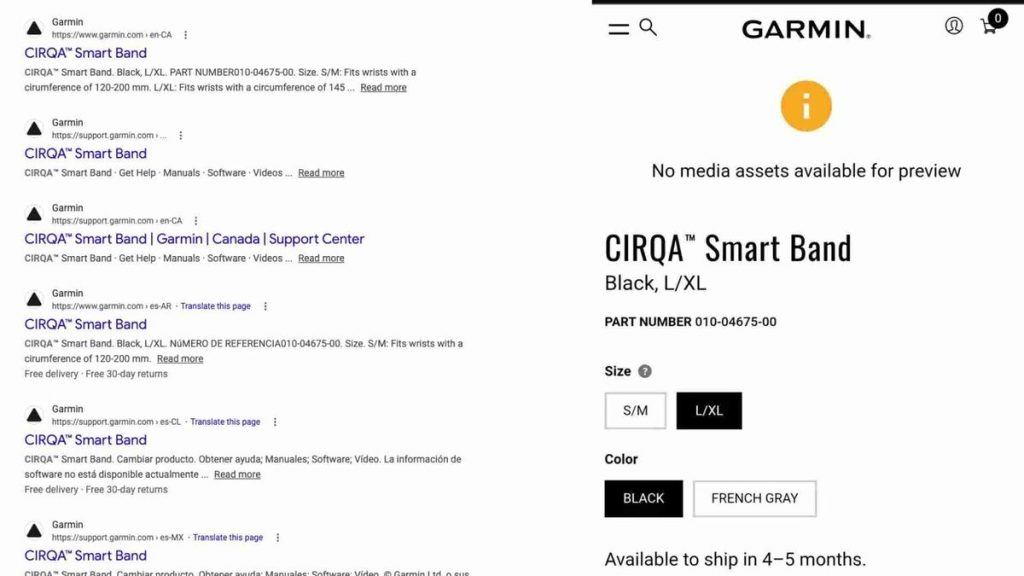
It also reportedly mentioned two colors: Black and French Gray.
Most importantly, this was not just a random retailer rumor. The report said the listing appeared on Garmin’s own Canadian site. That makes it one of the stronger early signals.
The same report mentioned a shipping estimate of four to five months. That timing has already slipped, so it should not be treated as an active launch window anymore. But the listing itself remains meaningful.
February 2026: U.S. Trademark Filing
The strongest public evidence is Garmin’s U.S. trademark filing for CIRQA.
Garmin International filed the CIRQA trademark with the USPTO on February 25, 2026. The description is unusually specific. It refers to a body-worn sensor for physiological data, bio-signals, recovery, alertness, and performance.
This matters because trademark descriptions often reveal the intended product category before the product itself is announced.
In Cirqa’s case, the language points clearly toward a recovery and health wearable, not a conventional smartwatch.
April 2026: Wearable Media Picks Up the Trademark
In April, specialist wearable sites started connecting the dots.
Gadgets & Wearables highlighted the CIRQA trademark and interpreted it as a likely recovery-focused device. That reading is consistent with the trademark language and with the earlier “Smart Band” leak.
By this point, Cirqa was no longer just a strange name from a leaked listing. It had a legal filing behind it.
May 2026: Retailer Design and Price Leak
In May, another wave of leaks appeared around a retailer listing.
Reports suggested that a Ukrainian retailer had shown what looked like a fabric-style Garmin Cirqa band. Some coverage also mentioned pricing around $509, though that number should be treated very cautiously.
Retailer prices before launch are often placeholders. Regional pricing can also be distorted by VAT, import margins, currency conversion, and pre-order mechanics.
The design leak is more interesting than the price. A fabric-style band would fit the idea of a lightweight, sleep-friendly, recovery-first device.
May 2026: Garmin Connect Clues
Around the same time, Gadgets & Wearables reported signs that Garmin Connect may be preparing for screenless or minimally interactive hardware.
This is weaker evidence than the trademark or Garmin Canada listing. It does not prove Cirqa directly. But it fits the bigger picture.
If Cirqa is screenless, Garmin Connect would need to become the primary interface. That would be very different from Garmin’s normal watch-first model, where the device itself carries much of the user experience.
June 2026: Singapore Certification Reports
In early June, The5KRunner and Notebookcheck reported that Cirqa appeared in Singapore certification coverage.
The key detail was the apparent Bluetooth-only profile. Reports did not point to built-in GPS, Wi-Fi, or ANT+.
That is exactly what we would expect from a lightweight recovery band. A device like this would not need to be a full sports computer. It would mainly collect biometric data and sync it to Garmin Connect.
This also makes Cirqa look less like a Vivoactive or Vivosmart successor and more like a new category inside Garmin’s ecosystem.
July 2026: Canada and EU Trademark Reports
By July 2026, reports pointed to additional CIRQA trademark activity in Canada and Europe.
That matters because multi-region trademark expansion usually means the company is protecting a product name for a broader launch. It does not guarantee release, but it makes cancellation less likely than if CIRQA were only a single isolated filing.
What We Know So Far
The name Cirqa is the most solid part of the story. Garmin filed CIRQA in the United States, and the same name reportedly appeared in Canada and EU trademark activity.
The product category is also becoming clearer. Garmin’s own trademark language describes a body-worn sensor focused on physiology, recovery, alertness, and performance.
The form factor is still not confirmed, but the strongest leaks point toward a smart band. The Garmin Canada listing reportedly used the phrase “Cirqa Smart Band,” and the size options, S/M and L/XL, make sense for a wrist-worn device.
The display situation is unknown. Several reports describe Cirqa as screenless or close to screenless, but Garmin has not confirmed this. A screenless design is plausible, but not proven.
The sensor stack is unknown. Based on the trademark, Cirqa almost certainly involves physiological sensing. Based on Garmin’s existing ecosystem, heart rate, HRV, sleep, stress, and recovery data would be logical. But the exact sensors have not been confirmed.
Built-in GPS looks unlikely, but not impossible. Certification-related reports suggested Bluetooth-only behavior and did not show clear evidence of GPS. That fits a recovery band, but Garmin has not published specs.
The price is unknown. The leaked retailer price around $509 is not reliable enough to treat as final.
Battery life is unknown. Any number circulating before Garmin’s official spec sheet should be treated as speculation.
The subscription model is also unknown. Some people have speculated about Garmin Connect+ integration, but there is no confirmed evidence that Cirqa will require or use a subscription.
Cirqa vs Garmin Index Sleep Monitor
This is the most important comparison.
At first glance, Cirqa may sound redundant. Garmin already has Index Sleep Monitor, an upper-arm band designed to track sleep and recovery data overnight.
But Index Sleep Monitor does not solve the same problem.
What Index Sleep Monitor Does Well
Garmin Index Sleep Monitor is a sleep-first product.
It is designed to be worn on the upper arm during sleep. It tracks sleep stages, HRV Status, breathing variations, skin temperature, Pulse Ox, stress during sleep, and related overnight metrics.
This is useful for people who do not want to wear a watch in bed.
It gives Garmin users a way to capture sleep data without sleeping with a Forerunner, Fenix, Epix, Venu, or other Garmin watch.
That is a valid product. But it is not a full wearable replacement.
Why Index Sleep Monitor Is Not a Primary Wearable
Index Sleep Monitor is not positioned as an all-day device.
Garmin’s own support material makes this clear indirectly. For features like Body Battery, Index Sleep Monitor depends on a compatible primary wearable with Body Battery TrueUp support.
In practical terms, that means Index Sleep Monitor is an accessory. It contributes sleep data into the Garmin ecosystem, but it does not become the user’s main wearable.
That matters because Garmin’s ecosystem is built around the concept of a primary device. When data overlaps, the primary wearable generally owns the core health and activity experience.
Index Sleep Monitor can improve the overnight part of the dataset. It cannot replace a watch as the central source of daily health, stress, movement, readiness, and performance context.
The Problem Cirqa Could Solve
Cirqa could solve a different problem: Garmin users who want continuous recovery tracking without wearing a full Garmin watch.
That includes users who:
Prefer mechanical watches during the day.
Do not want to sleep with a bulky sports watch.
Want recovery data but do not need a screen.
Want Garmin’s ecosystem without a visible smartwatch.
Want something closer to Whoop, but with Garmin Connect integration.
Need a lighter wearable for sleep and daily physiological monitoring.
This is where Cirqa becomes strategically interesting.
Index Sleep Monitor is for sleep coverage.
Cirqa could be for continuous recovery coverage.
That is a very different product role.
Cirqa vs Whoop
The obvious comparison is Whoop.
Whoop built its category around a screenless wearable, recovery scores, strain, sleep, HRV, and subscription-based analytics. Garmin already has many of the same metrics, but they are mostly attached to watches.
Cirqa could let Garmin compete with Whoop without asking users to wear a full smartwatch.
There are two possible advantages for Garmin.
First, Garmin already has a massive sports and health ecosystem. If Cirqa can integrate with Garmin Connect, Body Battery, HRV Status, Training Readiness, sleep tracking, and activity history, it could become more useful to existing Garmin users than a standalone recovery band.
Second, Garmin may be able to avoid the subscription problem. Whoop is heavily subscription-based. Garmin traditionally sells hardware first, although Garmin Connect+ has changed the picture somewhat. If Cirqa works well without a mandatory subscription, it could be a strong alternative.
But there is also a risk.
If Garmin limits Cirqa too much, requires a compatible primary watch, or locks important insights behind Garmin Connect+, it may not feel like a true Whoop competitor. It could become just another accessory.
Possible Garmin Cirqa Release Dates
There is no official launch date.
Still, the evidence suggests several realistic scenarios.
Scenario 1: North America First
This is the most plausible launch path.
The first known product listing leak came from Garmin Canada. The strongest trademark filing is in the United States. Canada trademark reporting followed later.
That pattern points toward North America as the most likely first-wave market.
A late summer or autumn 2026 launch would make sense if the product is still moving through Garmin’s pipeline. But this is an inference, not a confirmed date.
Scenario 2: Europe Shortly After
Europe also looks plausible because of reported EU trademark activity.
However, the EU trademark signal appeared later than the U.S. filing. That makes Europe-first less likely, unless Garmin plans a broad global announcement with staggered availability.
A September to October 2026 European rollout is possible, but not confirmed.
Scenario 3: Asia-Pacific Certification Path
Singapore certification reporting suggests Garmin may also be preparing Cirqa for Asia-Pacific markets.
Certification does not guarantee launch timing. It only shows that a device may be moving through regulatory steps.
This makes Asia-Pacific credible, but not the leading release scenario.
Scenario 4: Delayed Into 2027
This cannot be ruled out.
The original leaked Garmin Canada shipping window has already passed. That means Garmin either delayed the product, changed the rollout, or never intended that listing to go live when it did.
A CES 2027 or Q1 2027 launch is now a realistic fallback scenario.
That does not mean Cirqa is dead. It means the original timing was unreliable.
What We Still Do Not Know
The biggest unknowns are still the ones that will decide whether Cirqa is actually compelling.
We do not know if Cirqa has a display.
We do not know the final sensor stack.
We do not know whether it has Pulse Ox, skin temperature, ECG-like features, or advanced HRV sampling.
We do not know battery life.
We do not know if it works independently or requires a Garmin watch.
We do not know whether it can become a primary wearable inside Garmin Connect.
We do not know whether it will support workouts.
We do not know if it has GPS.
We do not know the final price.
We do not know if Garmin Connect+ will be involved.
Until Garmin announces the product, all of these remain open questions.
The Key Question: Accessory or Primary Wearable?
This is the part Garmin needs to get right.
If Cirqa is only an accessory, it may be less interesting. Garmin already has accessories. Index Sleep Monitor already covers the “I do not want to wear my watch at night” use case.
But if Cirqa can work as a proper primary wearable, the product becomes much more important.
That would allow Garmin to serve users who want health, sleep, HRV, stress, and recovery insights without using a traditional Garmin watch as their main device.
This is the real test.
A screenless Garmin recovery band is interesting.
A screenless Garmin recovery band that still depends on a separate Garmin watch is much less interesting.
Most Likely Product Positioning
Based on the current evidence, Cirqa is most likely to be positioned as a recovery-first smart band.
It probably will not replace Garmin’s sports watches for training, navigation, maps, structured workouts, cycling computers, or outdoor features.
It is more likely to sit below or beside the watch line as a lightweight biometric layer.
The strongest product positioning would be:
For users who want Garmin recovery and health tracking without wearing a full Garmin watch all day and night.
That is a clear market.
It is also a market Garmin does not fully serve today.
Bottom Line
Garmin Cirqa looks real enough to take seriously.
The evidence is not complete, but it is consistent. A Garmin Canada listing, the USPTO trademark filing, reported Canada and EU filings, and certification-related coverage all point toward a body-worn recovery device.
The most likely version of Cirqa is a lightweight Garmin recovery band, possibly screenless, possibly Bluetooth-only, and probably designed around Garmin Connect rather than on-device interaction.
The strategic logic is clear. Garmin has strong health and recovery analytics, but its ecosystem is still watch-centric. Index Sleep Monitor helps with overnight tracking, but it is not a primary wearable. Cirqa could fill the gap between a full Garmin watch and a sleep-only accessory.
The final question is whether Garmin will make Cirqa a real standalone recovery wearable or just another companion device.
If it is standalone enough, Cirqa could become one of Garmin’s most interesting wearable launches in years.
If it is too dependent on an existing Garmin watch, it may struggle to justify itself.
