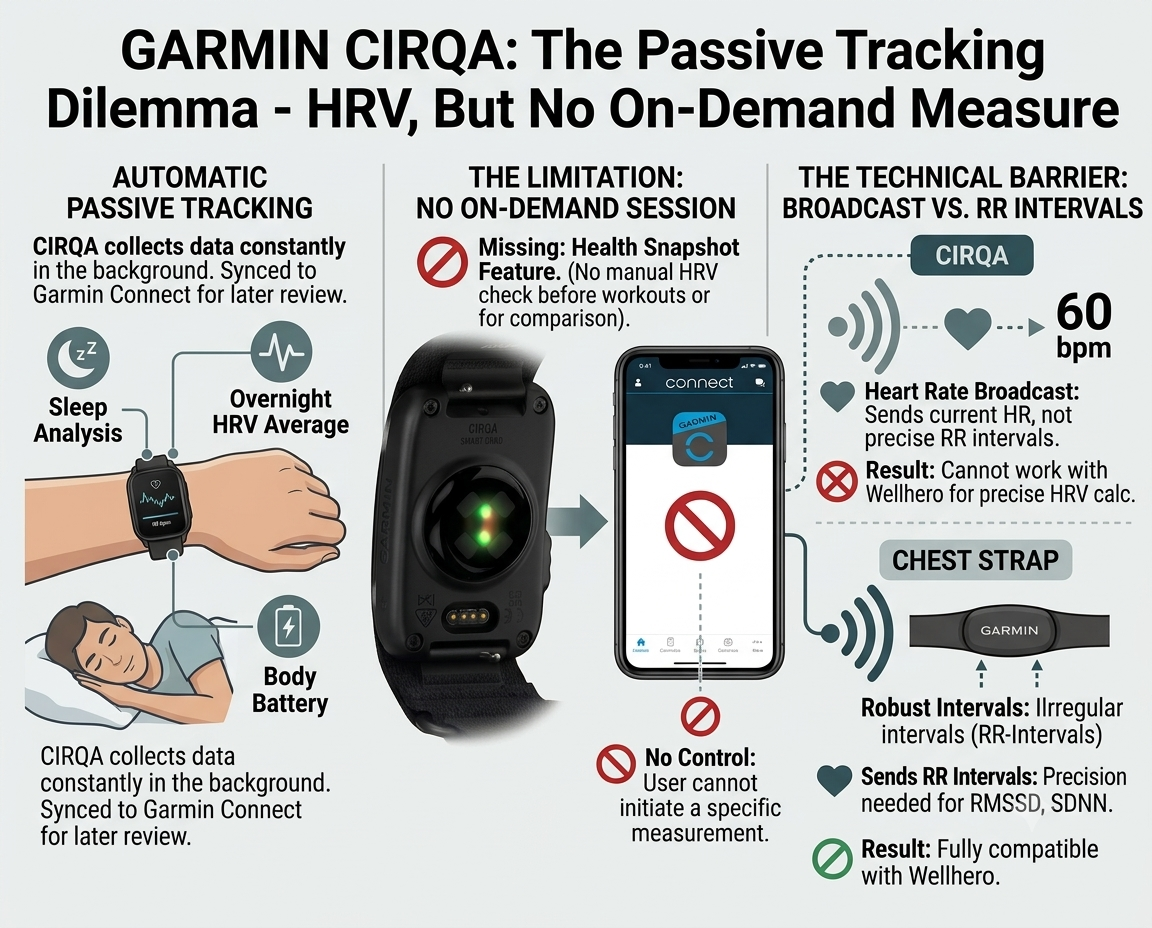
Garmin CIRQA HRV tracking works quietly in the background. The band records overnight HRV, heart rate, resting heart rate, sleep, stress, and other health metrics while you wear it. You can then open Garmin Connect and review the results without manually starting a measurement.
That approach works well for passive health tracking. However, CIRQA has one important limitation: you cannot measure HRV at a specific moment. You cannot sit down in the morning, start a two-minute session, and check your current result. You also cannot use the band as a standard external HRV sensor with an app such as Wellhero.
The device clearly collects the data required for HRV, but Garmin does not currently give users a way to access it on demand.
Garmin CIRQA Does Not Support Health Snapshot
Many Garmin watches include a feature called Health Snapshot. It lets you start a short measurement while sitting still. The session usually lasts around two minutes and records several health metrics, including heart rate and HRV.
Because you control when the session starts, Health Snapshot is useful for measurements taken under consistent conditions. You can run it after waking up, before a workout, after a demanding training session, or whenever you feel unusually tired or unwell.
Garmin CIRQA does not support Health Snapshot. The absence of a screen is not a major issue by itself because Garmin could allow users to start the session from Garmin Connect. However, the app does not currently provide that option either.
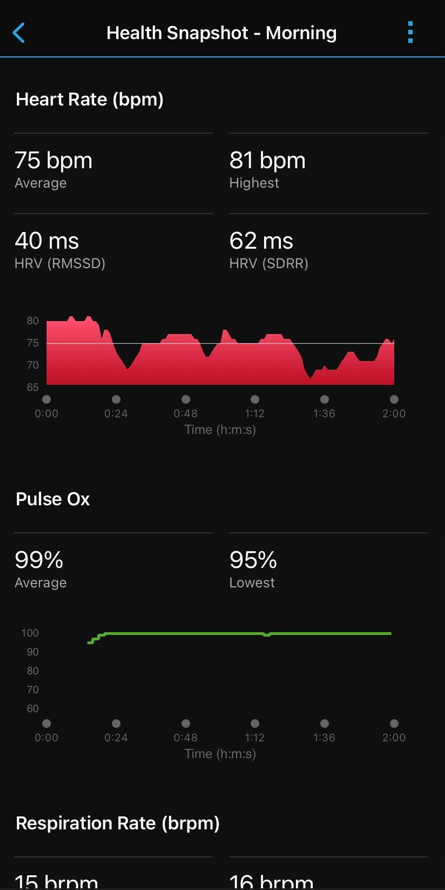
As a result, HRV on Garmin CIRQA is recorded automatically during sleep, but there is no way to start a separate measurement during the day. This does not mean that the optical sensor cannot measure it. Garmin already uses the data for overnight HRV, stress, and other recovery features. The limitation is that the user cannot choose when the measurement takes place.
Why Overnight HRV Is Not Always Enough
For many users, overnight tracking is the most useful way to monitor HRV. It is automatic, requires no additional effort, and gives Garmin several hours of data instead of relying on a short sample.
A manual measurement answers a different question. An overnight value summarizes what happened while you were sleeping, while a short session can show your condition at a specific moment. You may want to check it after waking up, before training, after poor sleep, during illness, or following a stressful day.
A manual HRV routine can also be easier to control. You can use the same body position, similar breathing, and the same time of day. This makes it easier to compare one result with another.
CIRQA handles passive overnight tracking well, but it does not support this controlled measurement use case.
Heart Rate Broadcast Does Not Provide RR Intervals Over Bluetooth
CIRQA can broadcast live heart rate to another device or application. At first, this looks like a possible workaround. You might expect to connect the band to an HRV app and run the measurement there.
The problem is that HRV applications need more than a current heart rate value. They require RR intervals, which represent the exact time between individual heartbeats. Metrics such as RMSSD and SDNN are calculated from the variation between these intervals.
A heart rate value such as 60 beats per minute does not provide enough information. The application needs to know whether the intervals between beats were 980 ms, 1,020 ms, 995 ms, and so on.
When CIRQA broadcasts heart rate over Bluetooth, it sends the current heart rate but does not include the RR intervals needed for an external HRV calculation. This means a phone application such as Wellhero can detect the band and display live heart rate, but it cannot calculate HRV from the data it receives.
What makes this limitation even stranger is that CIRQA does transmit RR intervals when broadcasting heart rate over ANT+. I confirmed this by recording an activity on a Garmin Venu connected to CIRQA as an external ANT+ heart rate sensor. The resulting FIT file contained RR interval data.
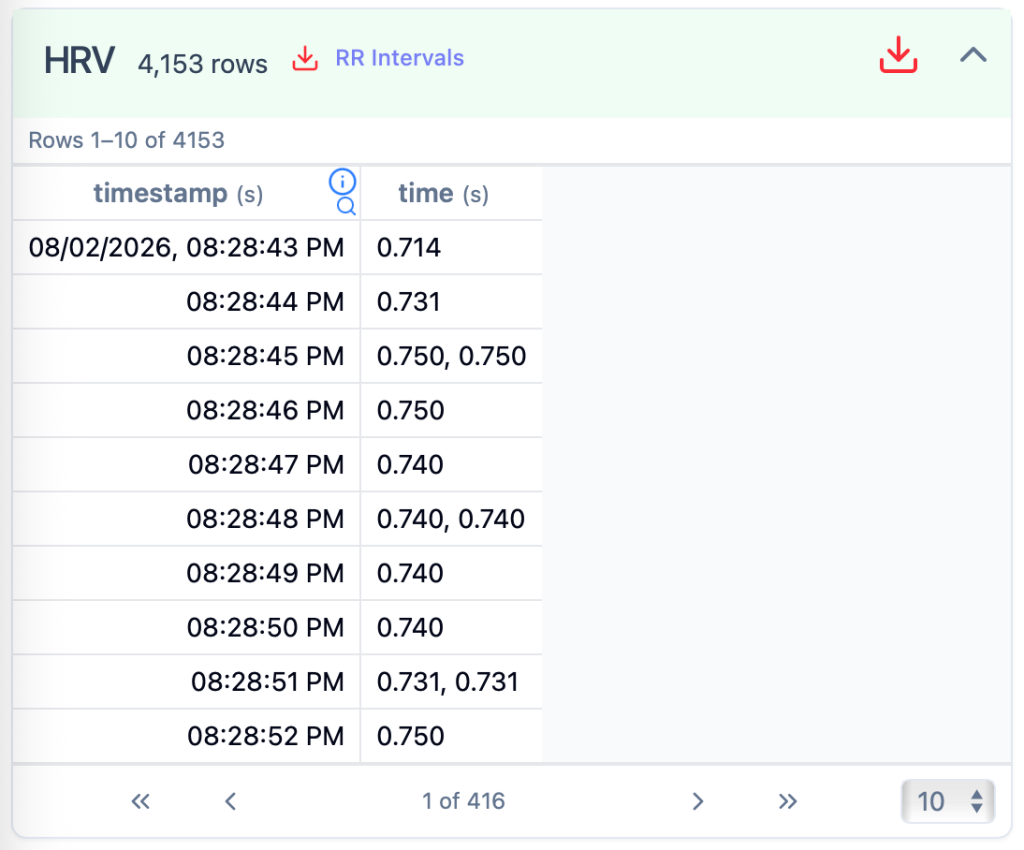
In other words, CIRQA already produces and transmits the required beat-to-beat information. Garmin simply makes it available over ANT+, but not through the Bluetooth connection used by most phone applications. This appears to be a limitation of the current Bluetooth broadcast implementation rather than a limitation of the optical sensor itself.
Heart Rate Broadcast over Bluetooth therefore cannot replace Health Snapshot or another manual Garmin CIRQA HRV measurement mode. At the same time, the ANT+ data shows that the hardware is already capable of supporting this use case.
Testing Garmin CIRQA HRV Measurements With Wellhero
I tested CIRQA with Wellhero, an application that can run short HRV measurements using a compatible external sensor.
Garmin chest straps work well with Wellhero because they transmit RR intervals. This allows the application to calculate HRV and related metrics. Compatible chest straps from other manufacturers work in the same way.
CIRQA behaves differently. Wellhero can detect the live heart rate sent by the band, but it does not receive RR intervals. Without those intervals, the application cannot calculate HRV.
This comparison makes the limitation clear. Garmin chest straps can provide the data needed for an on-demand measurement, while CIRQA cannot, even though the band already tracks HRV internally during sleep.
The sensor is not necessarily the problem. Access to the data is the problem.
What CIRQA Can and Cannot Replace
CIRQA can replace a smartwatch for several types of passive monitoring. It can collect sleep data, overnight HRV, resting heart rate, stress, and other daily metrics without adding another screen to your wrist.
That is one of the main reasons to use the device. You can wear a smaller screen-free band during work and sleep while keeping a Garmin watch for workouts and other activities.
However, CIRQA does not fully replace a Garmin watch for users who rely on Health Snapshot. It also does not replace a chest strap for applications that calculate HRV from RR intervals.
In my case, Garmin CIRQA works well for sleep and passive recovery tracking, but I still need a compatible Garmin watch or chest strap when I want to measure HRV at a specific time. The band reduces the need to wear a smartwatch throughout the day, but it does not remove the need for another device entirely.
How Garmin Could Improve HRV Measurement on CIRQA
The most obvious improvement would be to let users start Health Snapshot from Garmin Connect. The phone could control the session while CIRQA collected the data, so the band would not need a display or additional physical controls.
Another option would be to include RR intervals in Heart Rate Broadcast. This would allow CIRQA to work with Wellhero and other compatible HRV applications in the same way as a chest strap.
Garmin could also add a separate HRV measurement mode designed specifically for CIRQA. Users could start and stop the session from the phone and receive a short reading under controlled conditions.
Any of these options would improve the product without changing its screen-free design. CIRQA is intended for people who want Garmin health tracking without wearing a full smartwatch, and on-demand HRV would make that concept more complete.
Final Thoughts on Garmin CIRQA HRV Tracking
Garmin CIRQA HRV tracking works for passive overnight monitoring. The device collects data for overnight HRV, sleep, resting heart rate, stress, and other Garmin health metrics.
The missing feature is on-demand access. CIRQA does not support Health Snapshot, Garmin Connect cannot start a manual session, and Heart Rate Broadcast does not transmit RR intervals (via Bluetooth). Because of this, the band cannot be used as a complete HRV sensor with Wellhero.
Garmin chest straps do not have this problem because they transmit the RR intervals required for HRV calculations.
CIRQA can replace a smartwatch for sleep and everyday passive health tracking. For manual HRV measurements, however, you still need a compatible Garmin watch, chest strap, or another device that provides RR intervals.
