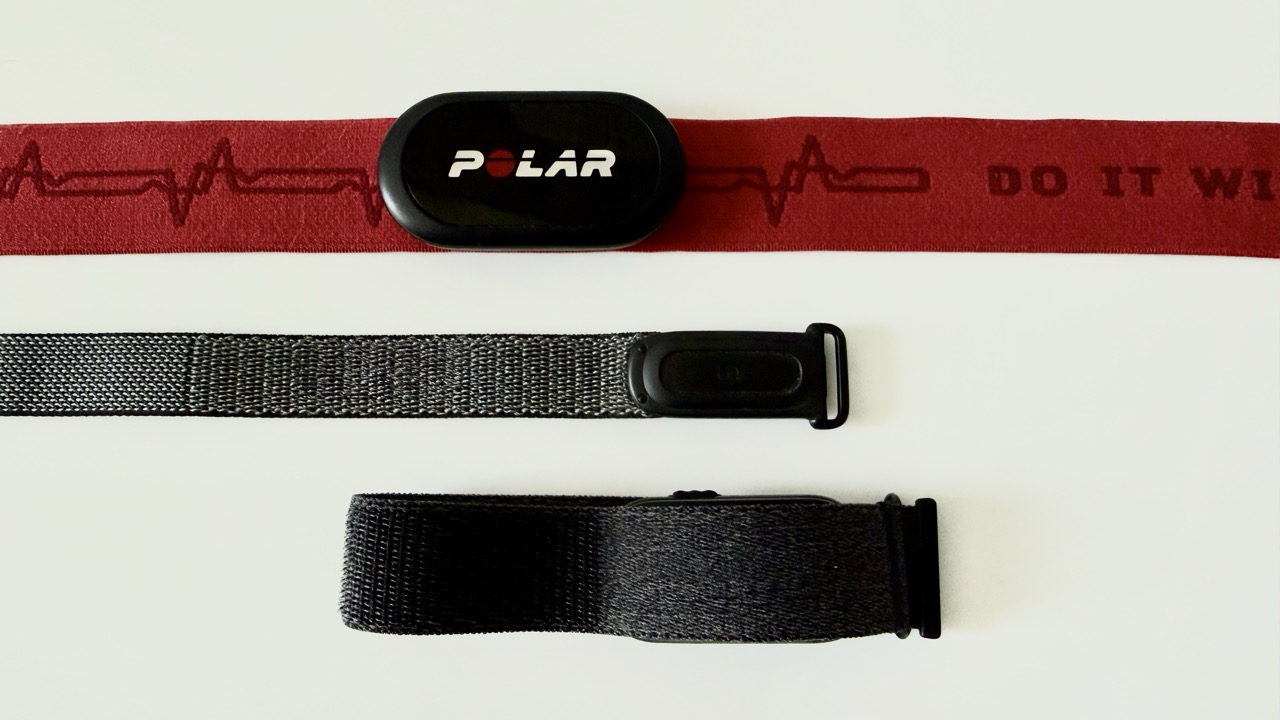
Garmin CIRQA and Fitbit Air are not really designed as dedicated cycling heart-rate monitors. They are fitness trackers intended to collect data quietly throughout the day, track sleep and recovery, and record heart rate during everyday activities.
That distinction matters.
I did not test them during structured intervals, short sprints, or repeated threshold efforts. Instead, I completed two normal road rides at a fitness-oriented intensity and compared both devices against a Polar H10 chest strap.
TLDR: both devices are more than good enough for tracking ordinary fitness rides, but Fitbit Air was more accurate in both tests.
There are, however, a few interesting details hidden behind that conclusion.
Test setup
During both rides, I used three devices simultaneously:
- Polar H10 as the reference chest strap
- Garmin CIRQA, broadcasting heart rate over ANT+ to a Garmin Venu
- Fitbit Air, with workout data later exported through Google Health
These are not identical data pipelines.
CIRQA calculates heart rate on the device, broadcasts the result to the Venu, and the watch saves it into a FIT file. Fitbit Air synchronizes through the Fitbit and Google ecosystem, after which the workout can be exported as a TCX file.
So this test compares the data a user can realistically obtain from each device. It does not isolate the optical sensors from the algorithms, recording devices, and possible post-processing involved.
Both tests were performed on a road bike and on paved roads. I will test both devices separately on gravel, where vibration and movement should present a much harder challenge.
The two rides were not identical
The first route included rougher pavement, along with several short climbs and descents through rolling terrain.
The second ride was conducted on substantially better asphalt and did not include the same repeated climbs and descents. It was a smoother and more consistent ride overall.
That difference is potentially important. Optical heart-rate sensors can be affected by vibration, wrist movement, device fit, changes in hand pressure, and movement between the sensor and the skin.
As a result, the stronger CIRQA performance in the second test cannot automatically be attributed only to a recording-setting change. The smoother road surface may also have contributed.
Test 1: Fitbit Air clearly ahead
The first ride was relatively steady, with heart rate spending much of the time around 130 to 145 bpm.
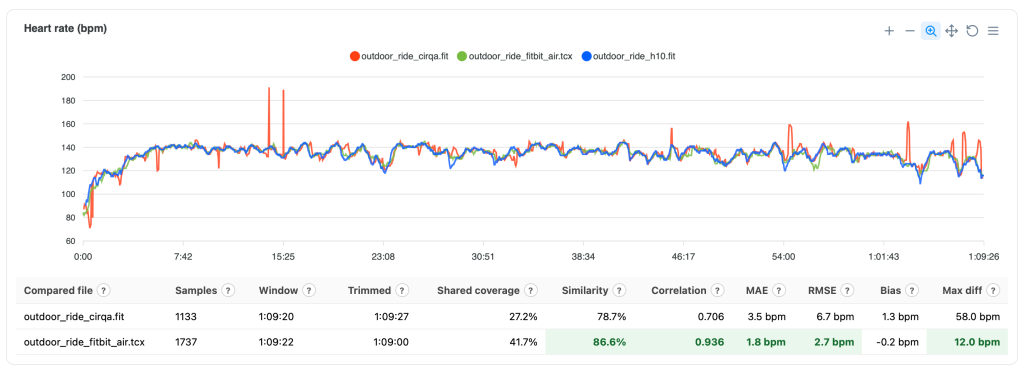
Fitbit Air vs Polar H10
- Mean absolute error: 1.8 bpm
- Correlation: 0.936
- RMSE: 2.7 bpm
- Bias: -0.2 bpm
- Maximum difference: 12 bpm
Fitbit Air tracked the Polar H10 closely for most of the ride. There were a few small local differences, but no major spikes and almost no systematic over-reading or under-reading.
For an optical fitness tracker used during outdoor cycling, this was a very strong result.
Garmin CIRQA vs Polar H10
- Mean absolute error: 3.5 bpm
- Correlation: 0.706
- RMSE: 6.7 bpm
- Bias: +1.3 bpm
- Maximum difference: 58 bpm
For most of the ride, CIRQA also followed the general heart-rate pattern reasonably well.
The larger errors came primarily from a small number of substantial artifacts.
For example:
| Garmin CIRQA | Polar H10 |
|---|---|
| 191 bpm | approximately 140 bpm |
| 189 bpm | approximately 131 bpm |
| 188 bpm | approximately 131 bpm |
There was also a longer episode where CIRQA gradually increased from roughly 129 bpm to 162 bpm while the Polar H10 remained close to 126 bpm.
This was not a charting artifact. I checked the source FIT file, and those values were already present in the data recorded by the Garmin Venu.
An interesting recording issue: only 27% shared coverage
In the first test, shared coverage was:
- CIRQA: 27.2%
- Fitbit Air: 41.7%
That does not mean CIRQA only recorded 27% of the ride.
All three files covered almost the entire comparison period. The difference came from how frequently each recording device saved heart-rate samples.
The Polar H10 recording from the Garmin Edge contained approximately one heart-rate point per second. The Venu, however, had Smart Recording enabled. This meant that the CIRQA heart-rate values were saved only every few seconds rather than continuously at one-second intervals.
Fitbit Air also produced fewer samples than the Polar recording, typically around one point every two or three seconds.
In this case, shared coverage describes sample density rather than the actual percentage of the ride during which the devices were operating.
Before the second ride, I changed the Venu from Smart Recording to Every Second.
Test 2: CIRQA gets much closer
The second ride produced a substantially better result for CIRQA.
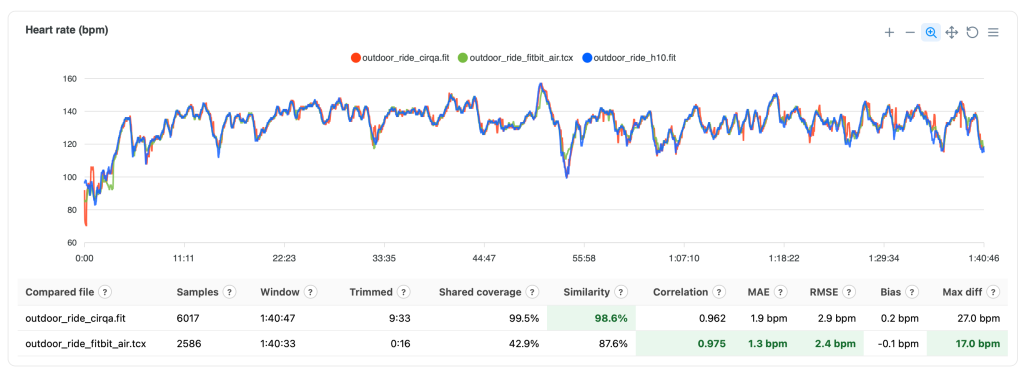
Fitbit Air vs Polar H10
- Mean absolute error: 1.3 bpm
- Correlation: 0.975
- RMSE: 2.4 bpm
- Bias: -0.1 bpm
- Maximum difference: 17 bpm
Garmin CIRQA vs Polar H10
- Mean absolute error: 1.9 bpm
- Correlation: 0.962
- RMSE: 2.9 bpm
- Bias: +0.2 bpm
- Maximum difference: 27 bpm
CIRQA’s shared coverage increased to 99.5%, which is exactly what I would expect after switching the Venu to one-second recording.
More importantly, the large spikes seen during the first ride did not repeat. The CIRQA trace stayed very close to the Polar H10 throughout most of the ride.
Fitbit Air still produced the better numbers, but the difference was now fairly small. Both devices recorded a mean absolute error below 2 bpm, and both followed the reference trace closely.
Combined results
| Ride | Device | MAE | Correlation | RMSE | Maximum difference |
|---|---|---|---|---|---|
| Test 1 | Garmin CIRQA | 3.5 bpm | 0.706 | 6.7 bpm | 58 bpm |
| Test 1 | Fitbit Air | 1.8 bpm | 0.936 | 2.7 bpm | 12 bpm |
| Test 2 | Garmin CIRQA | 1.9 bpm | 0.962 | 2.9 bpm | 27 bpm |
| Test 2 | Fitbit Air | 1.3 bpm | 0.975 | 2.4 bpm | 17 bpm |
Fitbit Air performed better in both tests:
- lower mean error
- higher correlation
- lower RMSE
- smaller large deviations
- virtually no consistent over-reading or under-reading
However, the gap was much smaller during the second ride.
What caused the CIRQA artifacts?
There is not enough information from two rides to identify a single cause.
Several explanations are plausible:
- temporary loss of a clean optical signal
- vibration from rough pavement
- movement of the device against the skin
- changes in hand position or pressure on the bars
- a temporary algorithm failure
- an error during ANT+ transmission or reception
The isolated spikes could simply be brief optical errors.
The longer false rise is more interesting. A gradual increase of roughly 30 bpm looks less like a single bad sample and more like the sensor temporarily locking onto a periodic movement pattern.
However, the second ride showed that this does not happen consistently.
Did Every Second recording improve CIRQA accuracy?
Not necessarily.
Switching the Venu from Smart Recording to Every Second clearly explains why shared coverage increased from 27.2% to 99.5%.
It does not necessarily explain why the underlying heart-rate accuracy also improved.
Smart Recording changes how often values are written into the FIT file. It should not fundamentally change how CIRQA measures heart rate or what it broadcasts over ANT+.
The second test also took place on much smoother asphalt and without the repeated short climbs and descents from the first route. That likely meant fewer vibrations, fewer changes in body position, and less movement between the tracker and the skin.
So two variables changed at once:
- the recording frequency
- the riding conditions
The second result may therefore reflect both denser recording and easier conditions for an optical sensor.
Does Fitbit Air have a better sensor?
That conclusion would go beyond what these tests actually show.
The CIRQA data path looks approximately like this:
Optical signal
→ CIRQA heart-rate algorithm
→ ANT+ broadcast
→ Garmin Venu
→ FIT file
The Fitbit Air path looks more like this:
Optical signal
→ Fitbit algorithms
→ synchronization
→ Google Health
→ TCX export
The CIRQA FIT file is relatively close to the real-time heart-rate stream sent to the Venu.
The Fitbit Air file was exported after synchronization through Google Health. It may have undergone additional filtering, smoothing, resampling, or artifact removal before export.
That does not mean Google Health definitely corrected the data. The available files do not reveal exactly what processing occurred. But the cleaner Fitbit Air trace does not, by itself, prove that its photodiodes or electronics are inherently superior.
The more defensible conclusion is:
Fitbit Air produced more accurate final workout data in both rides, but this test cannot separate sensor quality from algorithm quality and post-processing.
For most users, though, the final exported data is what matters.
Are they good enough for cyclists?
For normal road fitness rides, yes.
Both devices tracked:
- the overall heart-rate level
- longer increases and decreases in effort
- average ride heart rate
- broad time-in-zone estimates
- general training load
Fitbit Air was more consistent across both tests.
CIRQA had several major artifacts during the first ride, but performed very well during the second. That suggests the first result was not a permanent failure of the device, although CIRQA may be more sensitive to road vibration, fit, or specific riding conditions.
I deliberately did not test either device during short intervals. Fitness trackers often apply smoothing and can lag behind rapid heart-rate changes. Strong performance during steady road cycling does not guarantee equally strong performance during ten-second sprints or repeated hard intervals.
For structured interval training and precise real-time pacing, a chest strap remains the safer choice.
What about gravel cycling?
Both tests were conducted on a road bike and on asphalt.
Gravel riding should be a considerably harder test because of:
- higher vibration
- repeated impacts
- more upper-body movement
- frequent changes in grip
- greater movement between the tracker and the skin
I will test CIRQA and Fitbit Air on gravel separately. That should provide a better indication of whether the artifacts seen in the first CIRQA ride were related to road vibration and device movement.
Final thoughts
After two road rides, the result is fairly straightforward:
- Both Garmin CIRQA and Fitbit Air are accurate enough for ordinary road fitness rides.
- Fitbit Air was more accurate in both tests.
- CIRQA came very close to Fitbit Air during the second test.
- The large CIRQA artifacts from the first ride did not repeat.
- The first ride had rougher asphalt and more rolling terrain, while the second was smoother and flatter.
- The results do not prove that Fitbit Air has better optical hardware, because the two data pipelines are different.
For everyday cycling and general fitness tracking, I would be comfortable using either device. Fitbit Air currently appears more consistent, while CIRQA’s second result shows that it can also produce a very accurate heart-rate trace under favorable road conditions.
