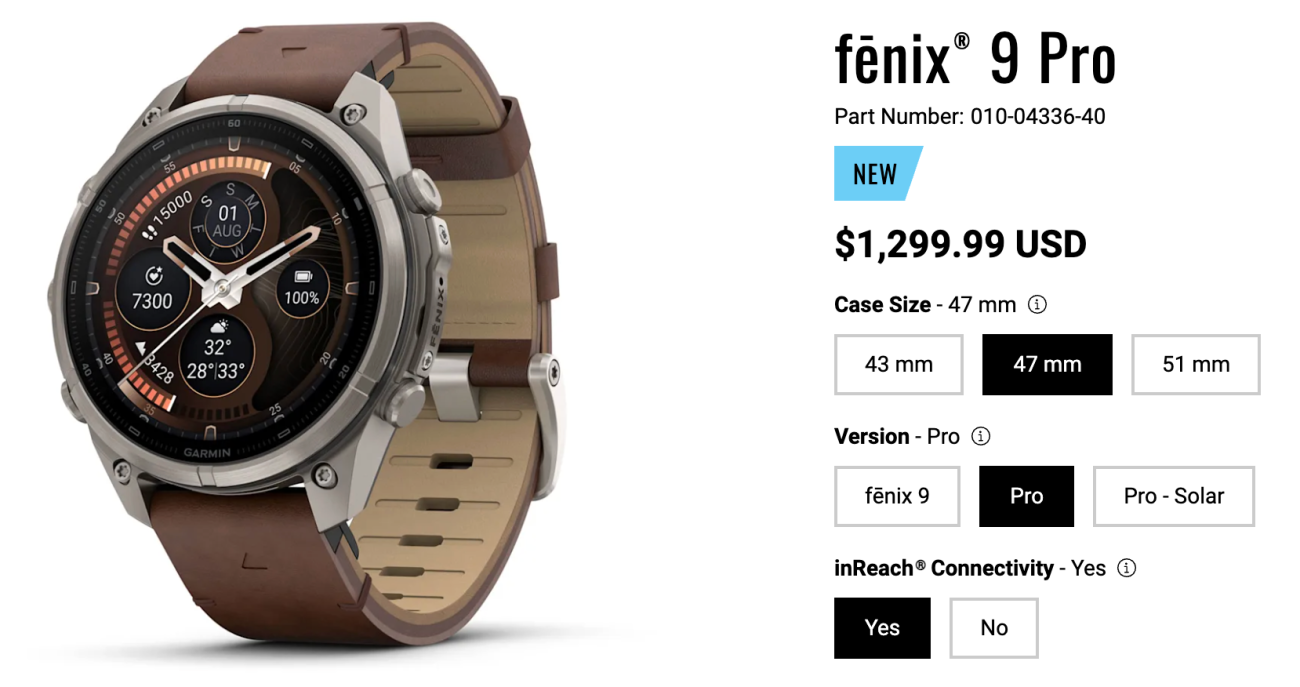
Garmin has introduced the fenix 9, and my first reaction after going through the specs was pretty simple:
Is that it?
The base fenix 9 starts at $999, while the Pro starts at $1,099. At that price, you would expect at least one change that would make a fenix 8 or fenix 8 Pro owner start looking for their credit card.
So far, I don’t see one.
Where is the new hardware?
Garmin hasn’t announced a new optical heart rate sensor or any fundamentally new health sensors. So if you were waiting for a new generation of heart rate, temperature, sleep, or recovery tracking, you’ll have to keep waiting.
The GPS situation is less clear. The watch still supports multi-band GNSS, but Garmin isn’t claiming any revolutionary new GPS hardware. On launch day, there are still almost no independent comparative tests of the fenix 9.
And that is especially interesting now that competitors like Google are seriously improving GPS accuracy. This year, Google made major improvements to dual-band GPS in the Pixel Watch 5, and early independent tests are showing very strong accuracy even in dense urban environments.
Garmin may still turn out to be better. But right now, there is no reason to consider GPS one of the reasons to buy the fenix 9.
So what actually changed?
The display is brighter. The Pro AMOLED now reaches up to 3,000 nits, and the 51 mm model finally gets a 1.5-inch display, 15% larger than the one in the fenix 8.
There is now 64 GB of storage. RAM has increased by 50%, and the new map engine promises scrolling that is up to 30% faster. The Pro gets a full titanium case. There are new Solar variants, and battery life has improved somewhat.
All of these are good improvements.
But this sounds more like the feature list for a fenix 8 Pro 2 than a new generation.
On the software side, Garmin added Garmin Epic for combining multiple activities into a single story, new Stamina Zones and Stamina Curve features, rowing VO2 Max, and expanded rucking support.
Useful to someone? Of course.
A reason to replace an expensive watch from the previous generation? Probably not.
What about inReach?
This is probably the most unusual part of the Pro lineup.
The fenix 9 Pro can send messages, trigger SOS, and use LTE without a phone. In some scenarios, that is genuinely useful: you can go for a run or a workout without your phone and still remain connected.
But for serious outdoor use, another question comes up:
If I genuinely need satellite communication, why wouldn’t I just buy a separate inReach?
Garmin itself warns that satellite and SOS functionality on the watch has limitations compared with other inReach devices.
A dedicated communicator also gives you an independent battery and a specialized device that can sit in your backpack and be used specifically when everything else has already gone wrong.
And if you already carry a modern iPhone, part of the emergency satellite use case is already covered by Apple’s satellite features. Availability is still geographically limited, so it is not a complete replacement for Garmin, but it makes the niche for built-in inReach on a watch even narrower.
The main question is no longer about hardware
What worries me more is something else.
If the fenix 8 and fenix 9 are this similar in hardware, Garmin has a very strong incentive to differentiate the generations through software.
And then the question isn’t whether the fenix 9 launches with a few exclusive features. That’s normal.
The question is whether Garmin will gradually start keeping more and more new functionality exclusive to newer models while slowing down meaningful feature updates for older watches, even when there is no technical reason they couldn’t support them.
There is no evidence yet that Garmin will do exactly that with the fenix 9.
But after an update this small, software support becomes one of the main things I would be watching.
So who actually needs the fenix 9?
If you’re buying your first Garmin, or upgrading from a fenix 6, an older fenix 7, or an Epix, the fenix 9 looks like an excellent watch.
If you specifically want MIP Solar in a modern Garmin flagship, the new lineup is also interesting.
If phone-free connectivity is important to you, the Pro has an additional reason to exist.
But for someone who already owns a fenix 8, and especially a fenix 8 Pro?
I currently see almost no rational reason to upgrade.
The fenix 9 doesn’t look like a bad product. It looks like a boring product.
Maybe this simply means Garmin’s sports watches have reached the stage where a new sensor, more accurate GPS, or a fundamentally new sports feature can no longer appear in every generation.
But if that’s the case, perhaps it would have been more honest to write this on the box:
fenix 8 Pro 2.
